
Categories
Epilepsy Foundation of San Diego

Camping with the Epilepsy Foundation of San Diego County

The Epilepsy Foundation of San Diego County invites our epilepsy community to share their thoughts as we explore partnerships with San Diego-based organizations to develop two unique camping experiences—one for kids & teens ages 8–17 with epilepsy, and another for families impacted by epilepsy.
01302026-Epilepsy-San-Diego-YMCA-camps

We’re excited to partner with the YMCA of San Diego County to explore a summer overnight camp experience for children and teens ages 8–17 living with epilepsy.

Important: All camps will have on-site, trained medical staff available to assist with seizures and any other medical needs, so families can feel confident and supported.

Camps would run Sunday through Friday and may be hosted at YMCA Camp Marston or YMCA Raintree Ranch. Camp Marston—San Diego’s oldest and best-known overnight camp—offers a classic outdoor camp experience, while Raintree Ranch is a western-themed paradise with a special focus on horseback riding and animal care.

Campers would enjoy outdoor adventures, group activities, and meaningful opportunities to build friendships in a supportive, inclusive environment where they can be themselves, try new things, and grow in confidence.

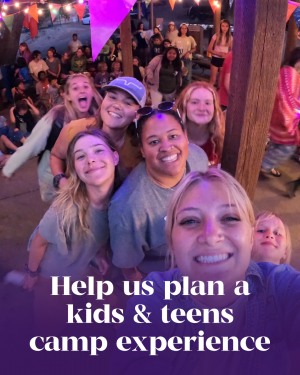
Help us plan a camp experience for kids & teens in 2026! We’re committed to developing a camp experience fitting for our community. If your child or teen may be interested in attending a summer overnight camp in 2026, please fill out our Kids & Teens Camp Interest Form.

NOTE: This form is not a registration, but your responses will help guide camp planning and offerings.
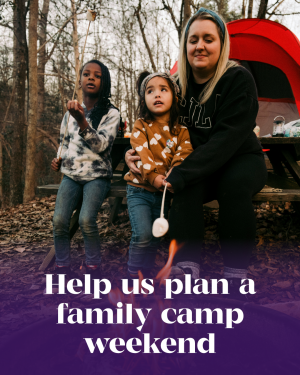
01302026-Epilepsy-San-Diego-family-camps

We’re also excited to explore the opportunity to offer a Family Camp weekend experience for families impacted by epilepsy, in partnership with the YMCA of San Diego County or the Boys to Men Mentoring Network.

This Friday–Sunday outdoor camp experience will be designed to bring families together for connection, rest, and fun in a supportive and inclusive environment.

Family Camp offers a chance to step away from daily routines, build meaningful relationships with other families who understand the epilepsy journey, and enjoy shared activities that strengthen family bonds.

Camp sessions will either be hosted at YMCA Camp Marston or the Boys to Men Mentoring Mt. Palomar property—both beautiful settings focused on community, confidence-building, and belonging.

Help us plan a family weekend camp experience  in 2026! If your family may be interested in attending a weekend camp experience in 2026, please fill out our family camp interest form.

NOTE: This form is not a registration, but your input is incredibly valuable. We look forward to exploring this opportunity together and imagining what Family Camp could become for our community.
Categories
Epilepsy Foundation of San Diego

Epilepsy Foundation of San Diego County on Transportation Access and Innovation

SAN DIEGO – “Safe, reliable transportation remains one of the greatest barriers for many individuals living with epilepsy. For those who cannot drive, getting to work, school, or a doctor’s appointment can take hours – multiple transfers, delays, and limited routes turn simple errands into exhausting journeys. For someone managing seizures, that unpredictability can be overwhelming.

Many in our community depend on public transit because they have no other choice and are often left out of the conversation. MTS is an essential service, but it simply isn’t meeting the needs of riders living with epilepsy and other disabilities. Long waits and inconsistent schedules can mean missed medical care, lost income, or trips abandoned altogether.

The constant possibility of a seizure also turns crowded public settings into a source of anxiety and stigma. Experiencing a seizure on a packed bus or busy station can be traumatic, for the individual and for those who may not know how to respond. More options mean fewer risks, fewer barriers, and greater independence.

Waymo’s arrival in San Diego matters because it represents possibility – shorter and more affordable trips, safer travel, and greater autonomy. It offers dignity, choice, and access to the everyday moments many take for granted.

This is not an either/or issue. We applaud efforts to strengthen MTS while expanding access to new mobility solutions. When San Diegans living with epilepsy have multiple transportation options, they gain opportunity – employment, healthcare, education, and true connection to their community.

We look forward to what this progress will bring and encourage local leaders to prioritize accessibility and innovation for those who need it most.”

– Rick Burritt, President and CEO
Epilepsy Foundation of San Diego County
Categories
Epilepsy Foundation of San Diego

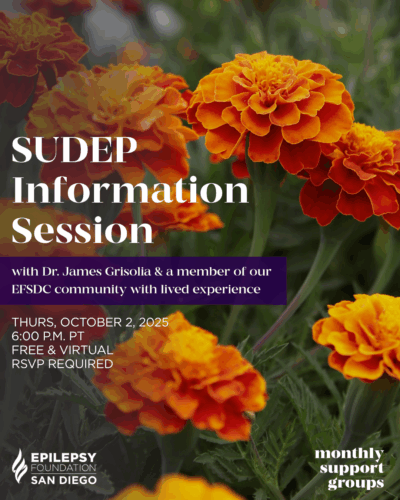
SUDEP Community Conversation: Bringing Awareness with Compassion

Sudden Unexpected Death in Epilepsy (SUDEP) is a fatal complication of epilepsy, occurring without warning and often in individuals with uncontrolled or frequent seizures.

If you’re unfamiliar with SUDEP, you’re not alone. It’s a topic that’s often overlooked or not openly discussed, even within the medical and epilepsy communities. It isn’t the easiest topic to talk about but that’s exactly why we need to talk about it.

During a virtual support session hosted on Thursday, October 2, we were honored to have Dr. James Grisolia, neurologist and epilepsy specialist, alongside a courageous family, Lynnette and Kent, who shared their lived experience of losing their son, Tim, to SUDEP.

Their stories and expertise helped us understand more about:

  • What SUDEP is and who it affects.
  • Risk factors and preventive strategies.
  • How to have meaningful conversations with care teams and loved ones.

This meaningful conversation brought SUDEP into the light but with compassion, honesty, and community—giving families the tools, information, and confidence they need to make informed decisions, reduce risk, and feel supported.

For those who were unable to attend the workshop or would like to review SUDEP materials, please review the SUDEP Facts and Dare to Say SUDEP documents by tapping on the following buttons.

If you or anyone else you know has been impacted by SUDEP or any epilepsy-related loss, we host monthly bereavement groups to help support families in their time of grief. Please reach out to Sarah Waters, MSW, ASW, at sarah@epilepsysandiego.org if you’re in need of support.

Categories
Epilepsy Foundation of San Diego

Many Thanks to the Mattei Family

We are honored and deeply grateful to share that the Epilepsy Foundation of San Diego County (EFSDC) has been named as a beneficiary of the Lee E. Mattei Family Trust, receiving a generous gift of approximately $175,000. We are also receiving an additional $47,000 from Ruth Mattei’s IRA, bringing the total impact of this contribution to over $220,000 in support of our mission.

Half of this remarkable contribution will support the Foundation’s ongoing charitable programs, while the other half has been used to establish a permanent endowment—the Epilepsy Foundation / Lee E. and Ruth S. Mattei Fund. The income generated from this fund will be used in perpetuity to further the charitable mission of EFSDC, helping to ensure long-term support for individuals and families affected by epilepsy.

Ruth S. Mattei, who passed away at the age of 101, met her husband Lee Mattei in San Diego. They were married for over 60 years until Lee’s passing in 2011. She was preceded in death by their only son, Gary. Together, Ruth and Lee built a successful development company responsible for many residential and commercial projects that helped shape San Diego’s historic growth.

Their legacy of building community continues through this incredible gift, and we are proud to honor their memory by carrying their generosity forward.

Categories
Epilepsy Foundation of San Diego Our Programs

Empoderando a Nuestras Comunidades Hispanohablantes

En la Fundación de Epilepsia del Condado de San Diego (EFSDC), estamos comprometidos a garantizar que las personas y familias de habla hispana tengan acceso a los recursos, la educación y el apoyo que necesitan. A través de nuestro Programa de Alcance en Español, colaboramos con organizaciones comunitarias locales para conectar directamente con clientes hispanohablantes y aumentar la concientización sobre la epilepsia.

Nuestros objetivos incluyen:

  • Reducir el estigma que rodea a la epilepsia en las comunidades de habla hispana.
  • Ofrecer capacitaciones en primeros auxilios para crisis epilépticas en español para empoderar a familias y cuidadores.
  • Aumentar la concientización sobre la frecuencia de la epilepsia y su impacto.
  • Ampliar el acceso a los programas, servicios y grupos de apoyo de EFSDC disponibles en español.

Al fortalecer estas conexiones, ayudamos a que más familias se sientan informadas, apoyadas y empoderadas mientras navegan los retos que implica vivir con epilepsia.

Para más información, contacto Marie Picazo, (619) 296-0161 x114 o Marie@epilepsysandiego.org.

Empowering Our Spanish-Speaking Communities

At the Epilepsy Foundation of San Diego County (EFSDC), we’re committed to ensuring that Spanish-speaking individuals and families have access to the resources, education, and support they need. Through our Spanish Outreach Program, we’re partnering with local community organizations to connect directly with Spanish-speaking clients and increase awareness about epilepsy.

Our goals include:

  • Reducing stigma surrounding epilepsy in Spanish-speaking communities.
  • Offering seizure first aid trainings in Spanish to empower families and caregivers.
  • Raising awareness about how common epilepsy is and its impact.
  • Expanding access to EFSDC’s programs, services, and support groups available in Spanish

By strengthening these connections, we’re helping more families feel informed, supported, and empowered when navigating epilepsy.

For more information, contact Marie Picazo, at (619) 296-0161 x114 or Marie@epilepsysandiego.org.

Categories
Epilepsy Foundation of San Diego

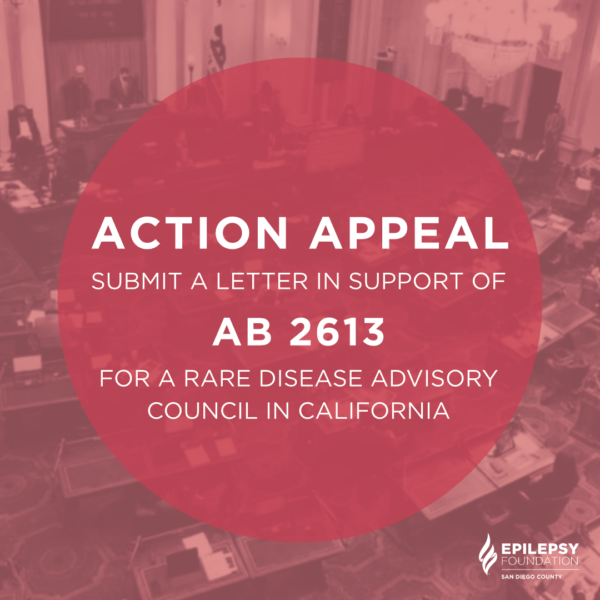
Advocate for a Rare Disease Advisory Council in California

On April 23, a bill to create a Rare Disease Advisory Council in California known as AB 2613 will be heard in the Assembly Health Committee. Please join the Epilepsy Foundation of San Diego County (EFSDC) and National Organization for Rare Disorders (NORD) in making sure the Committee hears from California advocates!

WAYS TO HELP

Submit a position letter by Sunday, April 21, 2024. Follow these steps:

  1. Write a letter, as short or as long as you’d like, addressed to the Assembly Committee on Health. For help, personalize and send this sample letter provided by the National Organization for Rare Disorders (NORD).
  2. Follow these instructions to submit your position letter through the California Legislature Position Letter Portal.

Reshare and engage with our social media post about AB 2613. These actions truly matter! When you reshare our Instagram, Facebook, LinkedIn and Twitter/X post helps put the appeal in front of people we wouldn’t otherwise reach without your support.

Patients with rare disorders face unique challenges every day, and lawmakers often struggle to understand the needs of the rare disease community. A Rare Disease Advisory Council will provide opportunities for patients and advocates throughout California to educate lawmakers and make formal policy recommendations to state leaders about pressing issues.

If we take this action together, we have an excellent chance of seeing our state create a Rare Disease Advisory Council. Please submit a position letter today!

Categories
Epilepsy Foundation of San Diego Our Stories

Ariana’s EpilepsySD Story

Having experienced seizures for the past 15 years, Ariana Green feels she can give support and encouragement to others by sharing her story. In fact, helping others who experience severe epilepsy is what she feels born to do.

“I have learned a great deal about how to cope with my condition and still have a great life full of wonderful experiences and adventures,” said Ariana.

“My story starts before I was born. The doctors detected an arachnoid cyst on my brainstem. It was about the size of a plum,” said the Mission Hills resident. As a result, Ariana began to experience life-threatening seizures that would last about 5-8 minutes long at the age of 3.

“I needed rectal Diazepam for them to stop,” she said. “We had to try something different.”

When Ariana was 5, her care was transferred to the Ronald Reagan UCLA Medical Center, where she met Dr. Jason Lerner, a pediatric neurologist, and Dr. Gary Mathern, a pediatric neurosurgeon. Ariana underwent a 9-hour partial hemispherectomy that removed the temporal, occipital and parietal lobes of her brain.

“The seizures stopped for two years but then came back,” said Ariana.

She continued to have different forms of seizures including partial seizures, focal seizures, and drop attacks over the next decade. At 15, she underwent a second operation, a procedure that took five hours to complete. “I had the RNS NeuroPace implant surgery that zaps the abnormal electrical activity before it spreads to the other side of my brain which stops the seizures. It has reduced my seizures by 75%.”

Staying connected to the epilepsy community in San Diego through The Epilepsy Foundation of San Diego County’s monthly support groups enables Ariana to meet new people who also live with epilepsy, and attending the Foundation’s annual conferences allows Ariana to hear doctors speak about the recent advances in medicine and treatment for those living with refractory epilepsy.

“I also enjoy speaking about my story because my situation is very unique in the fact that I am able to live with only half my brain compared to other people,” she said. “It is not easy for me to learn very complex subjects like math with half of my brain. It is a struggle, especially considering that I am required to take Calculus 1 in my first year of college next year. I am concerned that I won’t have any modifications to the class like I have now. I want to have as much support as possible so I can survive Calculus 1. I can’t wait to start college. I am excited.”

Ariana acknowledges that epilepsy isn’t easy to treat, that living with epilepsy is difficult sometimes, but believes in becoming seizure-free someday. It’s from that belief that Ariana encourages others to remain hopeful.

“Keep going so that you can envision seizure freedom and get where you need to be, which is an independent adult that is not relying on everyone to do things that you should be able to do yourself,” said Ariana. “Envision seizure freedom in your dreams at night. Do the hard work and you can get there.”

•••

We appreciate Ariana for sharing her epilepsy journey!

What have you learned from your epilepsy journey so far? Let us know by adding your experience to #MyEpilepsySDStory today!

Categories
Epilepsy Foundation of San Diego Our Programs

Introducing #MyEpilepsySDStory

We’re excited to mark International Epilepsy Day 2024 with the launch of #MyEpilepsySDStory, our new, year-round initiative that provides a platform for people in San Diego who are impacted by epilepsy to share their experience, and to see it alongside testimonies from others in the county affected by epilepsy.

Sharing our stories and seeing them together has healing and transformative power. Anyone who lives in San Diego County and is impacted by epilepsy is welcome to submit their story through our #MyEpilepsySDStory form. Once reviewed for appropriateness, submitted stories are added to the #MyEpilepsySDStory collection.

“It’s so important and special for me to have a community where I feel understood, and at the same time, feel I can help and support others,” shared Lisa, a member of EFSDC’s community who often attends our free, virtual monthly support groups. Lisa’s story is one of three narratives already available to read in our #MyEpilepsySDStory collection.

“Meeting friends and other people with epilepsy has made me feel less alone.”

If you have epilepsy, or are a parent, caretaker, relative, friend, teacher or coworker of someone who lives with epilepsy, your experience has meaning—especially to those who feel pressure to mask their journey. If we can speak and carry our truths together, we can shape a world that enables everyone impacted by epilepsy to thrive. Add your story to our collection today!

Categories
Epilepsy Foundation of San Diego Our Stories

Lisa’s EpilepsySD Story

Over the years, Lisa has seen many people be a part of the caring and supportive community nurtured by the Epilepsy Foundation of San Diego County through their participation in the Foundation’s events and Epilepsy Support Groups.

“We all have different experiences, but at the same time can connect with others who know what it’s like to have seizures, and the weight we all carry on a daily basis,” said Lisa.

For Lisa, the monthly support group meetings help cultivate community by providing space for people with epilepsy, as well as those who have loved ones living with epilepsy, to feel seen and heard which is especially important when epilepsy is still so misunderstood. Lisa appreciates how the meetings also provide opportunities to learn more about epilepsy from professionals and those with lived experience, such as ways to cope and to ask for help.

“It’s so important and special for me to have a community where I feel understood, and at the same time, feel I can help and support others,” said Lisa. “Meeting friends and other people with epilepsy has made me feel less alone.”

•••

Let us know what it’s been like for you to connect with San Diego’s epilepsy community. Add your experience to #MyEpilepsySDStory today!

Categories
Epilepsy Foundation of San Diego Our Stories

Len’s EpilepsySD Story

Relocating to a city can leave anyone feeling vulnerable, especially when someone lives with epilepsy. So, it can be a huge uplift to connect with others with similar lived experiences before establishing new roots.

“I was able to gain a feeling of community before I moved to the area,” said Len. For Len, being able to attend our series of Epilepsy Support Groups online and in real time has made an impact because they were able to reach many people ahead of moving to San Diego.

“It was great to feel that local connection, and see and hear stories about how I’m not alone in my disability from the moment I relocated to the area,” said Len.

•••

Are you someone who is impacted by epilepsy and new to San Diego? Let us know what it’s been like for you to connect with San Diego’s epilepsy community. Add your experience to #MyEpilepsySDStory today!